17.11.10

Burberry project


Here at TED we have been busy continuing to embed all our sustainable design thinking into the student's studio practice. Our latest project that tries out new ways to do this is called Inside/Outside, and is being sponsored and supported by Burberry.

The link between Chelsea College and Burberry is our location - we share the same neighbourhood by the Thames river at Millbank, and Burberry have been staging their twice-yearly fashion shows in our Parade Ground since 2009. In the 18th and 19th century, the site of the college used to be the infamous Millbank Prison, designed using Bentham's 'Panoptican' building design.

The project encourages students to uncover and revive vintage materials and historic processes that were current at the time of Millbank Prison, and to connect them to new, (often digital) textile processes and innovations of tomorrow.

Christopher Bailey, the Creative Director of Burberry has been to see the students and was keen to make the link between Burberry's heritage and his current design approach.

The programme includes a whole series of guest lecturers and workshops from people including Helen Carnac, curator of Taking Time: Craft and the Slow Revolution, new TED PhD student Maddy Aspinall who will teach the traditional technique of smocking and Zane Berzina, visiting lecturer from Weissensee College in Berlin, who specialises in textiles and soft technologies.

Watch the project as it unfolds on the student blog.with regular reflections and thoughts from the TED researchers.

16.11.10

New TED PhD students

We have two new PhD students starting with us at TED this year. The first student is Matilda Aspinall, who will be looking at historical garments and the way they were mended and repaired, to rediscover a series of techniques which could inspire and inform contemporary clothing producers to create garments with a longer life span.

This idea of 'textile precedents', that we have been mulling over at TED for a while, has now been integrated into TED's Design Strategies. Titled 'Look Back to Look Forward', this strategy asks how practices of the past can inform textile design and production of the future.

Matty has just been to the exhibition called Threads of Feeling, at the Foundling Museum in London, and reports below on what she saw.

The Foundling Hospital in London opened in 1741. Not a hospital in the true sense but a place to provide ‘maintenance and education for deserted young children.It was set up by philanthropist, Thomas Coram, who after returning from many years at sea, was appalled by the sight of young children left to die on the streets of London. The Foundling Hospital offered hope to poverty stricken young women who previously had to abandon their babies on the roadside or in the doorways of churches.

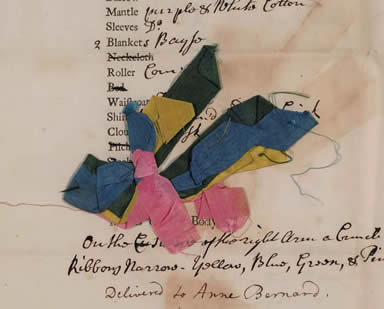
From 1741 to 1756 women leaving their babies at the hospital were invited to leave a token as a means of identification should they ever be in the position to reclaim them. Textile swatches were cut either from the mother’s clothing or the baby’s at the time of registration and then placed with a printed billet.

For many years these swatches have remained in storage in billet books in the London Metropolitan Archives too fragile to display. This exhibition, curated by historian John Styles, author of The Dress of the People: Everyday Fashion in 18th Century England, presents these precious swatches with insights into why such tokens were used (literacy rates were very poor) and snippets to give a rare glimpse into 18th century plebian fashion.

These fabrics now comprise the largest collection of everyday 18th century textiles surviving in Britain. Not only is there a wide range of fabrics, there are decorative ribbons, embroidery and even a few items of clothing. Each scrap of fabric conjures a poignant story reflecting the life of the child and its absent parents.

How wonderful to be able to view such extraordinary pieces of fabric. Such fantastic weaves, prints and textures. My two personal favorites were two separate, tiny detachable sleeves; sleeves being the perfect token to leave, as of course, there are two of them. Was the mother given the other sleeve?


Children’s clothing was generally created from disused adult clothing so these wonderful block printed textiles can really fire up the imagination to envisage what women of that era were actually wearing. Additionally, it is a great insight in to the extraordinary variety of clothing that the children of that time actually wore. The registration billet that was meticulously filed by the hospital clerk gives a 23 item-clothing checklist. These garments include: cap, biggin, frock, upper-coat, mantle, petticoat, pilch. Sadly, the majority of items weren’t ticked.

This was a fascinating, beautiful, heart breaking, extraordinary and a compelling study of surviving textiles, not only in understanding their physical nature and function but importantly, their cultural significance .


By Matilda Aspinall, TED PhD student

9.11.10

Eco Textiles in Tilburg

The work of several TED members is currently on show in reTHINK!: Eco Textiles at the Audax Textile Museum in Tilburg, Holland.

The show is an overview of the lifecycle of textile production from a sustainability point of view and includes the work of independent designers as well as commercial textile companies from the Netherlands.

Several of us showed pieces that were made during the Ever & Again project, or work that was developed after, in response to all the ideas and new thinking the project generated.

Becky Earley is showing one of her upcycled polyester Top 100 shirts, Mel Bowles is showing her Wallpaper Dress, Clara Vuletich is showing her Love & Thrift coat and Gary Page is showing two items from his wonderful 1-2-5 Collection of dresses.

Kate Goldsworthy, who is also showing a new garment made using laser technology to re-invigorate polyester, is also running a one day workshop on using laser technology for upcycling in January.

There is a good review of the show in Dutch site Design.nl.

26.10.10

TED's Sustainable Design Strategies At Work


Becky Earley has recently been out and about promoting TED's Sustainable Design strategies to commercial clients. In March this year Becky introduced the strategies to designers from the Gucci Group at a TFRC event, and in May to a larger range of professionals at a PPR group event in Cambridge.

Last week's workshop at the Sustainable Fashion Academy in Stockholm, Sweden, was attended by twenty delegates from industry. They were designers, marketing and innovation managers from a broad range of Swedish companies, including H&M.

Yesterday’s one-to-one sessions were part of Becky’s return visit to the Future Factory project in Nottingham, based at Nottingham Trent University. Five local businesses had 40 minute sessions to further explore sustainable design concepts that they had been introduced to in the spring this year.

For all the delegates the work and information around materials and manufacturing are so important, but being introduced to the ‘soft’ eco design concepts prove to be just as useful. One Swedish participant wrote back last week:

“I thoroughly enjoyed yesterday… When I got home last night, I honestly couldn't stop thinking about the Seven Design Strategies that Becky presented during the day and the in particular the ideas on ‘Replace the Need to Consume’ and ‘Design Activism’. From my perspective those two areas seems to be as much about communication as production and with my background in communication, pr and marketing those ideas triggered my creativity. After listening to Becky I believe that there are plenty to do in those areas as well...”

If you would like more information about the consultancy workshops TED run, please contact Clara on ted@chelsea.arts.ac.uk

17.10.10

TED Postcard from Melbourne

The talk I gave on our Upcyling Textiles project in Melbourne was a success, with about 35 people joining us at the new Harvest Textiles workspace. The talk was the first event at the space, that will house their screen printing workshops, a gallery space and a retail shop. They have some grand plans to run artists-in-residence programmes and all sorts of talks and events, so watch their space!

I introduced the audience to the work of all the TED members and the outcomes from the Ever & Again project. There were some interesting questions from the floor, including the question we get asked the most about the project - 'Are all these great ideas actually commercially viable?'.

The next talk will be to staff and students at RMIT University textile department on Tuesday.

14.10.10

TED postcard from Sydney

For the workshop I ran yesterday at University of Technology Sydney (UTS), the students made their own small patchwork sample, using fabric scraps. Taking a few basic quilting shapes as templates, we explored the idea of zero-waste cutting and hand-stitching. Several students had never used a needle and thread, so we worked slowly and quietly. At the end all of the pieces were brought together to make one whole 'quilt' which we photographed, and will then digitise and play around with using CAD tools.

I also presented a talk on 'Digital Craft' exploring the work of 'hybrid designers' such as weaver Ismini Samandiou and my work of 'digital quilting' called Fragments.

The students are involved in a project called 'Waste in the City' run by Marie O'Mahony. They have been put in groups and have been assigned an area of the city, and each group has been mapping the waste of that area, to identify any potential design interventions, using the local waste stream. The groups consist of students from a range of design disciplines, including visual communication and textile/fashion design, so the range of solutions should be interesting, and from the few ideas I heard, will mainly focusing of designing services around waste re-use.

13.10.10

Ethical Fashion Forum’s SOURCE EXPO 2010

Last week two of TED’s PhD students (Jen Ballie and Matilda Aspinall) attended the Ethical Fashion Forum’s SOURCE EXPO 2010.
The SOURCE EXPO aimed to promote sustainable fashion practices and facilitate sustainable sourcing amongst fashion professionals. The exhibition showcased a selection of work from suppliers and manufacturers from all over the world, working to promote fair trade and ethical standards, linking them with hundreds of designers, retailers and brands.
A series of seminars were also scheduled throughout the day, and we attended the ‘Innovation’ seminar to learn about the latest inspirational products and processes in the sourcing sector. This was chaired by Emily Pearce, EFF’s Ethical Fashion Project Manager, with speakers from Initiate Design, Bag it Don’t Bin It and Pants to Poverty. The work of Susanne Lee (Biocouture) and PUMA SAFE - Clever Little Bag was also introduced.
Each speaker introduced their innovativion by explaining their design concept, how their product was made and any additional services. We were impressed at the range of challenging design approaches adopted by each speaker. The subjects discussed explored local production and cottage industries, cradle to cradle design through closed loop methodologies and crowdfunding.
The session explored how design could be coupled with innovation to create desirable products that were both useable and engaging. The end user played a central focus through each strategy and they tried to engage users by encouraging participation, supporting well-being and promoting social values.
This event has scaled up since last year and attracted a massive audience. It was exciting to see designer’s working in new ways to scale up sustainable design.