Showing posts with label Design Strategies. Show all posts

17.12.10


Clara Vuletich was at the Ethical Fashion Forum's Excellence in Ethical Fashion Training Day last week as an 'expert' in sourcing sustainable materials. Clara saw several different independent fashion companies and designers who were looking for advice and guidance.

It turned out that the most helpful advice Clara could give was a copy of TED's TEN Design Strategies. There is often an assumption in the ethical fashion world that fashion and textile designer's already have the design skills needed, and all they need guidance with is issues such as marketing, sourcing and finding the right production supply chain. However, here at TED we would argue that the complexity of sustainability requires designers to work with a range of interconnected design strategies that can leverage real innovation and change and that are not just limited to the 'hard' aspects such as materials and processes.

This may include awareness and understanding of how service design approaches could be helpful, or how to design in the potential for upcycling at the end of the garment's life. This is where our TED's TEN comes in.

While TED has been developing this set of design strategies for several years now, there have been other recent attempts to offer strategies or 'toolkits' for designers to navigate sustainability. There is a set of values for slow fashion developed by Slow Fashion Forward in Sweden, and the Slowlab with Alistair Fuad-Luke have developed a set of strategies to design 'slowly'. Finally, there is a Toolkit for Designers who want to learn how to be Social Innovators from Ezio Manzini's organisation DESIS.

Most of these , are quite broad and conceptual and not specifically related to a textile and fashion context. We believe TED's TEN fills this gap.

16.11.10

New TED PhD students

We have two new PhD students starting with us at TED this year. The first student is Matilda Aspinall, who will be looking at historical garments and the way they were mended and repaired, to rediscover a series of techniques which could inspire and inform contemporary clothing producers to create garments with a longer life span.

This idea of 'textile precedents', that we have been mulling over at TED for a while, has now been integrated into TED's Design Strategies. Titled 'Look Back to Look Forward', this strategy asks how practices of the past can inform textile design and production of the future.

Matty has just been to the exhibition called Threads of Feeling, at the Foundling Museum in London, and reports below on what she saw.

The Foundling Hospital in London opened in 1741. Not a hospital in the true sense but a place to provide ‘maintenance and education for deserted young children.It was set up by philanthropist, Thomas Coram, who after returning from many years at sea, was appalled by the sight of young children left to die on the streets of London. The Foundling Hospital offered hope to poverty stricken young women who previously had to abandon their babies on the roadside or in the doorways of churches.

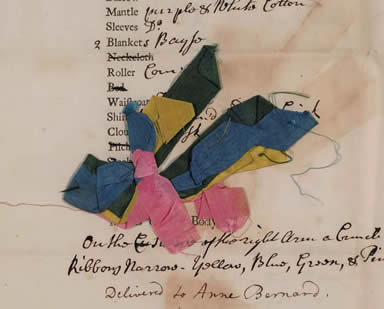
From 1741 to 1756 women leaving their babies at the hospital were invited to leave a token as a means of identification should they ever be in the position to reclaim them. Textile swatches were cut either from the mother’s clothing or the baby’s at the time of registration and then placed with a printed billet.

For many years these swatches have remained in storage in billet books in the London Metropolitan Archives too fragile to display. This exhibition, curated by historian John Styles, author of The Dress of the People: Everyday Fashion in 18th Century England, presents these precious swatches with insights into why such tokens were used (literacy rates were very poor) and snippets to give a rare glimpse into 18th century plebian fashion.

These fabrics now comprise the largest collection of everyday 18th century textiles surviving in Britain. Not only is there a wide range of fabrics, there are decorative ribbons, embroidery and even a few items of clothing. Each scrap of fabric conjures a poignant story reflecting the life of the child and its absent parents.

How wonderful to be able to view such extraordinary pieces of fabric. Such fantastic weaves, prints and textures. My two personal favorites were two separate, tiny detachable sleeves; sleeves being the perfect token to leave, as of course, there are two of them. Was the mother given the other sleeve?


Children’s clothing was generally created from disused adult clothing so these wonderful block printed textiles can really fire up the imagination to envisage what women of that era were actually wearing. Additionally, it is a great insight in to the extraordinary variety of clothing that the children of that time actually wore. The registration billet that was meticulously filed by the hospital clerk gives a 23 item-clothing checklist. These garments include: cap, biggin, frock, upper-coat, mantle, petticoat, pilch. Sadly, the majority of items weren’t ticked.

This was a fascinating, beautiful, heart breaking, extraordinary and a compelling study of surviving textiles, not only in understanding their physical nature and function but importantly, their cultural significance .


By Matilda Aspinall, TED PhD student

26.10.10

TED's Sustainable Design Strategies At Work


Becky Earley has recently been out and about promoting TED's Sustainable Design strategies to commercial clients. In March this year Becky introduced the strategies to designers from the Gucci Group at a TFRC event, and in May to a larger range of professionals at a PPR group event in Cambridge.

Last week's workshop at the Sustainable Fashion Academy in Stockholm, Sweden, was attended by twenty delegates from industry. They were designers, marketing and innovation managers from a broad range of Swedish companies, including H&M.

Yesterday’s one-to-one sessions were part of Becky’s return visit to the Future Factory project in Nottingham, based at Nottingham Trent University. Five local businesses had 40 minute sessions to further explore sustainable design concepts that they had been introduced to in the spring this year.

For all the delegates the work and information around materials and manufacturing are so important, but being introduced to the ‘soft’ eco design concepts prove to be just as useful. One Swedish participant wrote back last week:

“I thoroughly enjoyed yesterday… When I got home last night, I honestly couldn't stop thinking about the Seven Design Strategies that Becky presented during the day and the in particular the ideas on ‘Replace the Need to Consume’ and ‘Design Activism’. From my perspective those two areas seems to be as much about communication as production and with my background in communication, pr and marketing those ideas triggered my creativity. After listening to Becky I believe that there are plenty to do in those areas as well...”

If you would like more information about the consultancy workshops TED run, please contact Clara on ted@chelsea.arts.ac.uk